Call for International Participation - 3rd International Indigenous Language Journalism Conference – 2026
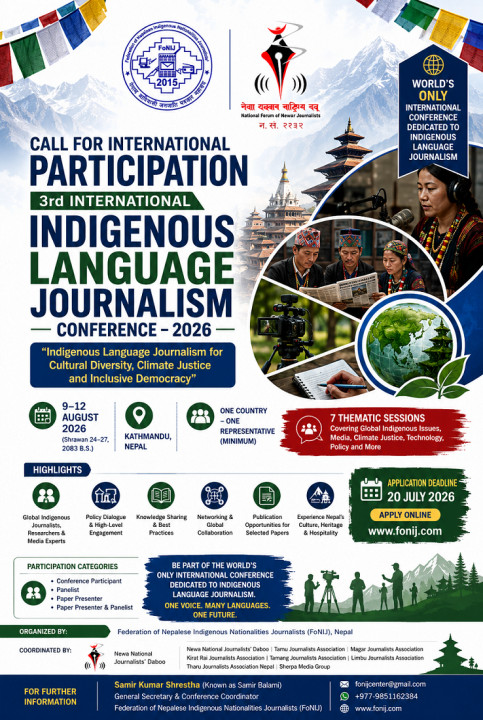
Call for International Participation
3rd International Indigenous Language Journalism Conference – 2026
One Country – One Representative (Minimum)
Theme
"Indigenous Language Journalism for Cultural Diversity, Climate Justice and Inclusive Democracy"
Date: 9–12 August 2026
Venue: Kathmandu, Nepal
Organized by: Federation of Nepalese Indigenous Nationalities Journalists (FoNIJ), Nepal
Call for Participation
The Federation of Nepalese Indigenous Nationalities Journalists (FoNIJ) is pleased to invite applications from Indigenous journalists, Indigenous language journalists, editors, media professionals, researchers, academics, communication specialists, Indigenous leaders, policymakers, and representatives of media and Indigenous organizations from around the world to participate in the 3rd International Indigenous Language Journalism Conference – 2026, to be held in Kathmandu, Nepal, from 9–12 August 2026, in conjunction with the International Day of the World's Indigenous Peoples.
This international conference will serve as a global platform for Indigenous journalists, media practitioners, scholars, policymakers, development partners, and communication experts to exchange knowledge, share experiences and best practices, strengthen international collaboration, and explore innovative approaches for advancing Indigenous language journalism in the context of cultural diversity, climate justice, inclusive democracy, and emerging technologies.
To ensure broad international representation, FoNIJ intends to select at least one Indigenous representative from each country, subject to the quality of applications, geographical balance, and conference capacity.
Conference Objectives
The conference aims to:
- Promote Indigenous language journalism globally.
- Strengthen international collaboration and solidarity among Indigenous journalists and media organizations.
- Exchange knowledge, experiences, innovations, and best practices in Indigenous journalism.
- Support the preservation, promotion, and revitalization of Indigenous languages through media.
- Foster dialogue on climate change, climate justice, and Indigenous resilience.
- Highlight Indigenous knowledge systems, customary governance, and traditional institutions.
- Promote discussions on forest rights, REDD+, biodiversity conservation, sustainable natural resource management, and Indigenous stewardship.
- Showcase Indigenous agriculture, food systems, and traditional ecological knowledge.
- Examine digital transformation, Artificial Intelligence (AI), and emerging technologies in Indigenous media.
- Discuss policies and institutional practices that support Indigenous language journalism.
- Build a strong international network of Indigenous journalists, researchers, and media organizations.
- Develop practical recommendations for governments, media institutions, development partners, and international organizations.
Conference Themes and Sessions
Applicants are requested to select one preferred thematic session and indicate whether they wish to participate as a Participant, Panelist, Paper Presenter, or both.
Session 1 : Global Status of Indigenous Language Journalism and the International Decade of Indigenous Languages
Session 2 : Climate Change, REDD+, Forest Rights, Biodiversity, and Indigenous Knowledge Systems
Session 3 : Indigenous Agriculture, Food Security, Traditional Knowledge, Biodiversity, and Sustainable Livelihoods
Session 4 : Technology, Artificial Intelligence (AI), Digital Transformation, and Indigenous Language Journalism
Session 5 : Indigenous Issues in Mainstream Media: International Media Dialogue
Session 6 : Policies and Practices of Indigenous Language Journalism
Session 7 : Customary Governance, Indigenous Institutions, and High-Level Policy Dialogue
Participation Categories
Applicants may apply as:
- Conference Participant
- Panelist
- Paper Presenter
- Paper Presenter & Panelist
Applicants should clearly indicate their preferred participation category in the application form.
Eligibility
Applicants should:
- Be an Indigenous journalist, Indigenous language journalist, editor, media professional, researcher, academic, communication specialist, Indigenous leader, or policy expert.
- Be affiliated with a media organization, academic institution, Indigenous organization, or apply independently.
- Demonstrate active engagement in journalism, Indigenous media, communication, research, or related fields.
- Be able to participate throughout the conference.
Paper Submission Requirements
Applicants wishing to present a paper should submit the following along with their application:
- Paper Title
- Extended Abstract or Concept Paper (300–500 words)
- Three to Five Keywords
- Short Biography (approximately 150 words)
- Preferred Conference Session
The abstract or concept paper should clearly explain the proposed topic, objectives, key arguments, methodology (where applicable), expected outcomes, and its relevance to the conference theme.
Required Application Documents
Applicants should submit:
- Completed Application Form
- Curriculum Vitae (CV)
- Passport Copy
- Passport-size Photograph
- Short Biography
- Brief Personal Profile
- Contact Details
- Organization Name (if applying through an institution) or indicate Independent Applicant
- Extended Abstract or Concept Paper (300–500 words) for paper presenters
- Letter of Nomination or Recommendation (required for institutional applicants; optional for independent applicants)
- Organization Profile (optional)
- Self-declaration or supporting evidence confirming Indigenous identity
- Copies or links to published articles (optional but highly encouraged), particularly on:
- Indigenous language journalism
- Climate change
- Forest rights
- REDD+
- Biodiversity and conservation
- Indigenous knowledge systems
- Customary governance
- Indigenous peoples' relationship with forests
- Indigenous media and communication
Selection Process
Applications will be reviewed by the Conference Selection Committee based on:
- Professional experience and contribution
- Quality and relevance of the submitted abstract
- Geographic representation
- Conference capacity
Successful applicants will receive:
- Official Notification of Selection
- Official Invitation Letter
- Conference Schedule and Programme
- Presentation Guidelines
- Visa Support Letter (upon request)
- Other conference-related information and instructions
Presentation Requirements for Selected Participants
Selected Paper Presenters and Panelists will be required to submit, before the conference:
- A Full Conference Paper, or
- A Presentation Report, or
- A PowerPoint Presentation
Detailed submission guidelines, formatting requirements, and submission deadlines will be communicated to all selected participants.
Presentation Details:
- Presentation Time: 10–15 minutes
- Language: English or an Indigenous Language with English interpretation or translation
- PowerPoint presentations are encouraged.
Publication Opportunity
Outstanding conference papers, presentation reports, and presentations submitted by selected participants will be considered for publication in the Official Conference Proceedings, conference publications, FoNIJ journals, or other official publications, subject to editorial review and approval. Selected works may also be featured through FoNIJ's official communication platforms and future knowledge-sharing initiatives to promote Indigenous language journalism internationally.
Travel and Hospitality
International participants are expected to arrange their international travel to and from Nepal either:
- Independently; or
- Through support from the Embassy or Consulate of Nepal, their respective governments, universities, organizations, development partners, or other sponsoring institutions.
FoNIJ will provide selected international delegates with a Five-Day Hospitality Package, subject to conference provisions, including:
- Participation in the Four-Day International Conference
- Accommodation
- Meals during the conference
- Local transportation related to official conference activities
- Conference materials
- Certificate of Participation
Application Deadline
20 July 2026
Late or incomplete applications may not be considered.
Applicants are requested to submit all required documents electronically by email before the deadline.
Join Us in Kathmandu
We warmly invite Indigenous journalists, Indigenous language media practitioners, researchers, academics, communication experts, Indigenous leaders, and media organizations from around the world to join us in Kathmandu for this important international gathering.
Together, we will strengthen Indigenous language journalism through international cooperation, knowledge exchange, solidarity, innovation, and collective action for cultural diversity, climate justice, and inclusive democracy. We look forward to welcoming you to Nepal.
Conference Secretariat
Kathmandu, Nepal
For Further Information
Samir Kumar Shrestha
(Known as Samir Balami)
General Secretary & Conference Coordinator
Federation of Nepalese Indigenous Nationalities Journalists (FoNIJ)
Email: fonijcenter@gmail.com
WhatsApp: +977-9851162384
Web : www.fonij.com
Click here to fill out the form.
https://docs.google.com/forms/d/e/1FAIpQLSfcmpv4Tehpbh1rgnVyVeLQCSsO1C4QOCPHKqCnRoamCVnNPA/viewform?usp=dialog
